Debt Snowball vs Avalanche: Which Should You Use?
Both methods have you pay the minimum on every debt and put every spare dollar toward one target. The only difference is which debt you target first.
Snowball: smallest balance first
List debts from smallest to largest balance. Throw extra money at the smallest. When it's gone, roll its payment into the next one.
- Fast early wins keep you motivated
- Fewer bills to track sooner
- Can cost more interest
Avalanche: highest interest rate first
List debts from highest to lowest APR. Throw extra money at the most expensive one, then roll the payment down the list.
- Never costs more interest than snowball
- Usually finishes at the same time or sooner
- First payoff can take longer
A worked example
Say you have a $3,200 credit card at 24.9% APR ($90 minimum), an $850 store card at 19.9% ($30 minimum) and a $9,400 car loan at 6.9% ($240 minimum), and you can add $200 a month on top of the minimums.
Snowball pays off the store card in month 4, the credit card in month 15 and the car loan in month 27. Avalanche goes after the 24.9% credit card first and pays it off in month 13, then the store card in month 15 and the car loan in month 27.
Both are debt-free in 27 months. Avalanche costs about $1,580 in interest and snowball about $1,623, so here the faster first win costs roughly $43. Try your own numbers in the debt payoff calculator.
Which one to choose
If your rates are close, or you've struggled to stick with a plan before, choose snowball: the motivation is worth more than the small difference. If one debt has a much higher rate and you're confident you'll stay consistent, choose avalanche. Either way, the extra monthly payment matters far more than the order.
Questions
Is snowball or avalanche faster?
With the same monthly payment, avalanche usually pays everything off a little sooner or at the same time, because less of your money goes to interest. Snowball pays off individual debts sooner.
How much does avalanche save?
It depends on how different your interest rates are. With similar rates the gap is tiny; with one high-rate card and one low-rate loan it can be hundreds or thousands. Run your own numbers in the calculator.
Can I combine the two?
Yes. Many people knock out one very small balance first for a quick win, then switch to highest-interest-first.
More guides
How to plan your 2027 · 2027 US holidays · 2027 week numbers · Working days in 2027 · UK bank holidays 2027 · Canada holidays 2027 · Christmas countdown · Thanksgiving countdown · New Year countdown · The 50/30/20 rule explained · How to make a budget · Sinking funds · How to use a digital planner · Best paper for printing planners · How to print and bind a planner · How to frame printable wall art · Large-print puzzles for seniors · Homeschool printing supplies checklist
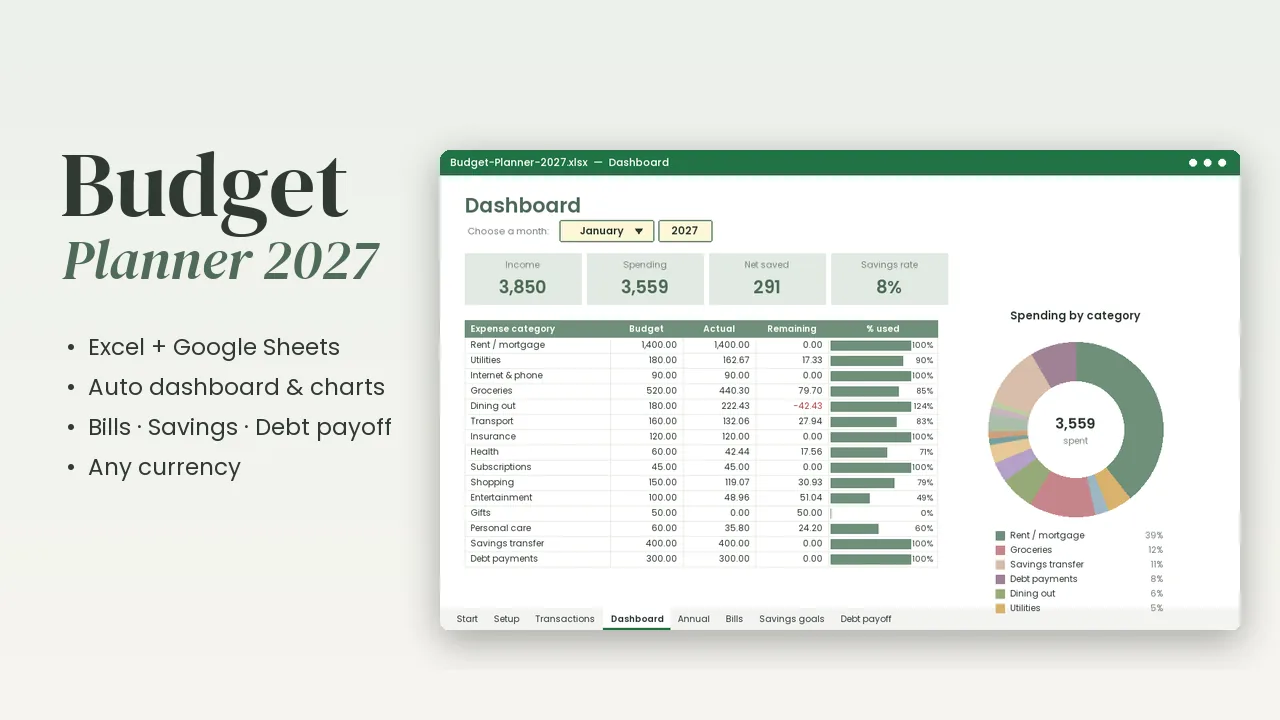
Budget Planner 2027 spreadsheet
Excel & Google Sheets: transaction log, monthly dashboard with charts, bills, savings goals and a debt payoff planner.